
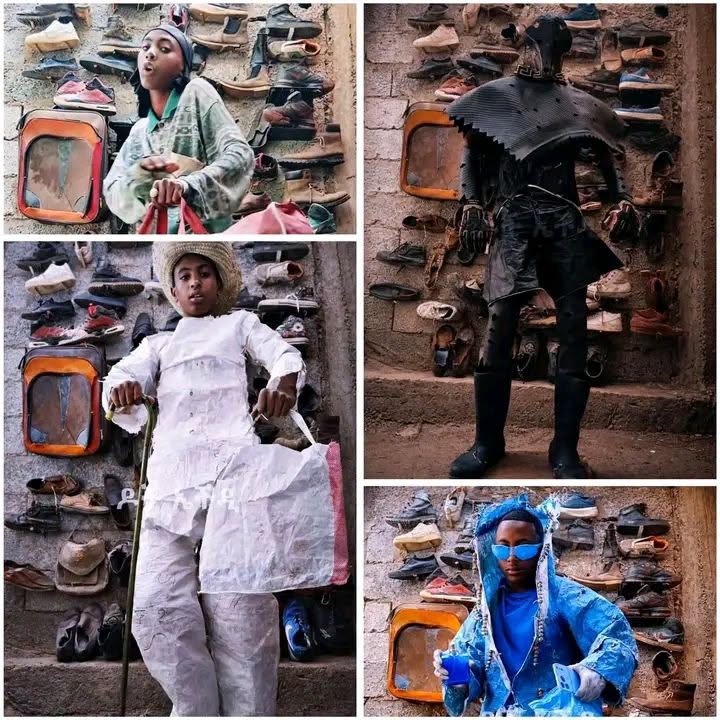
At first glance, Kalu Putik sits outside the traditional frameworks of the fashion industry. He does not appear to have access to a sophisticated studio, luxurious materials, or the conventional production circuits. And yet, this Ethiopian creator is steadily capturing growing attention online—precisely because of the constraints shaping his social and creative environment.
In this sense, his work marks a clear departure from the established codes of contemporary fashion, where value is often tied to the rarity of materials, the refinement of finishes, and the scale of available resources. With Kalu Putik, the process begins at the opposite end: the ordinary, the worn, the discarded. The question then becomes: how does he turn limitation and decay into a creative language?
AN AESTHETICS OF REAPPROPRIATION
The first key to his creative strength lies in his ability to transform what is immediately available into a coherent aesthetic system. Where others see waste, he sees potential—possibilities, fashion outcomes waiting to be realized.
Everyday objects, abandoned materials, worn-out textiles: these elements become the raw components of an exploratory yet cohesive visual language. Beyond recycling or DIY ingenuity, his work embodies a controlled form of reappropriation. Each piece he creates tells a story of tension between modest origins and elevated visual ambition.
But this ability also reflects an inner disposition—a way of magnifying what little one has, beyond what one hopes for or believes one should possess. In this sense, Kalu Putik suggests that it is only by accepting one’s own “grit,” without turning it into a fatal condition, that one can skillfully reach the level of refinement one aspires to. Accepting one’s condition—without glorifying it or submitting to it—becomes the very condition for achieving a bold, optimistic, and serene form of self-reinvention.
This approach produces an immediate effect: it blurs traditional hierarchies between what is considered “noble” and what is labeled “ordinary.” Kalu Putik effortlessly disrupts these distinctions—a worn-out shoe or a piece of plastic can suddenly enter into dialogue with the codes of haute couture.
STAGING AS AN EXTENSION OF THE GARMENT
With each creation, Kalu Putik constructs an entire universe, intuitively grasping the dynamics of hype in order to embody it. The staging of his now-viral videos relies on an improvised runway. The mobility and instability of this makeshift platform—composed of a wooden plank mounted on a rolling base—adds a dynamic layer to the viewing experience.
The surrounding set, built from an accumulation of salvaged objects, with backgrounds saturated with shoes and materials, reinforces this aesthetic of stylish resourcefulness. It is not incidental—it is part of the message. It contextualizes the pieces and amplifies their narrative impact.
This choice is crucial in a digital environment saturated with polished, highly produced imagery. In Kalu Putik’s work, the garments capture attention just as much as his presence, his gestures, his alignment with the mood, the music, and the overall atmosphere of each scene. He creates visual tableaux that are instantly recognizable, almost performative. In other words, while presenting a fashion collection, the Ethiopian artist is simultaneously staging his vision.
THE BODY AS A TOOL OF NARRATION
Another defining element: he embodies his own creations. This positioning reinforces several dynamics. First, a perceived authenticity—he does not outsource the representation of his work. Second, a strong artistic coherence, where the creator becomes part of the artwork itself. And third, a performative dimension, akin to live art.
By gradually styling himself using reclaimed materials that he reveals step by step, he does not simply present the final result—he exposes part of the process, the mechanics of transformation. This aligns perfectly with social media formats, where “before/after” narratives and metamorphosis are especially powerful.
VIRALITY ROOTED IN DISRUPTION
Kalu Putik’s virality stems from the originality of both his creations and his aesthetic approach. But it also relies on a more subtle mechanism: surprise.
In a visual landscape dominated by smooth, polished, calibrated, and often flashy aesthetics, his work introduces a form of dissonance. It captures attention precisely because it disrupts expectations.
Three key factors explain this traction: contrast (between limited resources and visual richness), immediate readability (the concept is instantly understood), and symbolic reproducibility (it gives the impression that anyone could try something similar at home). This last point is crucial—it turns the viewer into a potential creator, fostering engagement and sharing.
A RESPONSE TO CONTEMPORARY CHALLENGES
Beyond aesthetics, the rise of figures like Kalu Putik speaks to broader dynamics of our time. First, it operates as an implicit yet incisive critique of overconsumption. By restoring value to discarded materials, his work requalifies what surrounds us. It shifts our perception of what we call “waste,” revealing it less as an end point than as a failure of collective imagination.
In a context shaped by environmental urgency, this approach resonates with growing concerns around sustainability, resource depletion, and waste accumulation. Where ecological discourse sometimes struggles to mobilize, his work operates differently—it makes alternative modes of production and consumption tangible, perceptible, even desirable.
In this sense, such artistic practices can begin to outline a form of solution. Not a technical or industrial one, but a cultural and psychological response. It proposes a shift in perception: learning to see potential richness in scarcity, and reinvention within the worn.
The real issue may lie here: as long as waste remains invisible or despised, it will continue to proliferate. But once it becomes material for creation, it re-enters a cycle of value. The artist becomes a mediator between the rejected and the desired, helping to reshape our awareness—and ultimately, our practices.
Kalu Putik’s approach also reflects the democratization of creative tools. In the age of social media, visibility no longer depends exclusively on institutions. Where recognition once flowed through galleries, critics, schools, and patrons, the digital era reshuffles the hierarchy. A smartphone, a strong idea, and coherent execution can be enough to emerge and exist publicly—even if success is never guaranteed.
Within the African ecosystem, this shift carries particular weight. It allows creators long excluded from official circuits—due to lack of resources, networks, or conformity to imposed standards—to bypass these filters. Visibility is no longer solely conditioned by external validation, often rooted in normative or even exogenous frameworks. It becomes more direct, more organic, sometimes raw.
This shift has a major positive effect: it pluralizes narratives, allowing them to escape flattening in both form and substance. Aesthetics, materials, and imaginaries once deemed minor, informal, or non-compliant now find space for expression and reception. What was marginalized by institutional gatekeeping re-emerges as legitimate—sometimes even avant-garde.
It also reshapes the relationship with the audience. The artist no longer operates within a restricted circle of prescribers but can reach a broader, more diverse, and often more responsive audience. Beyond being spectators, audiences become relays, amplifiers, even co-validators. This proximity reduces the symbolic distance between creation and reception, encouraging a form of collective ownership.
Finally, this democratization revalues self-taught paths and forms of local ingenuity. It shifts the center of artistic legitimacy: no longer defined solely by institutions, but also by the relevance of perspective, the coherence of execution, and the ability to generate collective resonance—perhaps even algorithmic resonance.
Institutions do not disappear or become obsolete, but their monopoly over what is considered “valid” is weakening. And within that opening, figures like Kalu Putik find both space and a new form of assertive, nonconformist power.
Ultimately, Kalu Putik’s rise reveals a deeper transformation: the shift from a resource-based fashion to a narrative- and identity-driven one. The material or its market value becomes secondary to meaning. The garment becomes a site where stories, trajectories, and ways of being in the world are inscribed. What matters now goes beyond what we wear—it lies in what it expresses about who we are, our context, and the perspective we choose to hold on our shared humanity.
IN THE END
What Kalu Putik proposes is a redefinition of luxury. We move away from accumulation and ostentatious brilliance toward ingenuity. This is the new luxury: the ability to create meaning with very little. It signals a form of inverted wealth, where intellectual agility, creative vision, and boldness become the true markers of value.
Within this framework, Kalu Putik’s creations stand as visual manifestos: proof that constraint can be fertile, that imperfection can be aesthetic, and that creativity remains—more than ever—an unevenly distributed resource.